In today’s competitive online marketplace, businesses need a strong digital marketing strategy to attract customers and generate consistent sales. Two of the most powerful methods for increasing online visibility are Search Engine Optimization (SEO) and Google Ads (PPC).
But which one is better for your business?
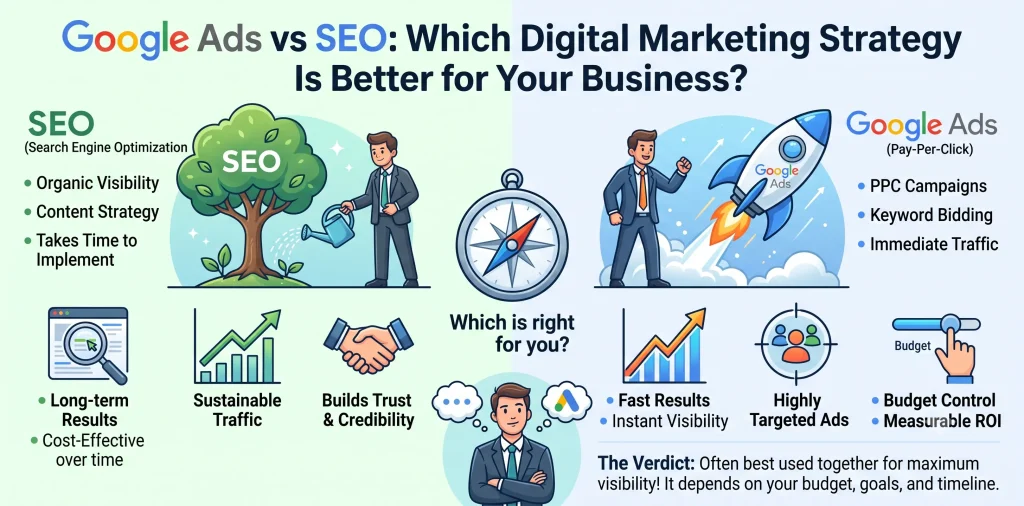
The answer depends on your goals, budget, industry, competition, and how quickly you want results. SEO can help build long-term organic visibility, while Google Ads can provide immediate visibility for targeted searches. Understanding the difference between the two can help you make a smarter marketing decision.
What Is SEO?
Search Engine Optimization, commonly known as SEO, is the process of improving a website so that it can rank higher in organic search engine results.
For example, if someone searches for “digital marketing agency in Pune,” businesses with well-optimized websites may appear in the organic search results.
SEO generally includes:
- Keyword research
- On-page SEO
- Technical SEO
- Content marketing
- Link building
- Local SEO
- Website optimization
- Competitor analysis
The goal is to increase relevant organic traffic without paying for every individual click.
What Are Google Ads?
Google Ads is a paid advertising platform that allows businesses to display advertisements when people search for relevant keywords.
For example, a digital marketing agency may create an advertisement targeting keywords such as:
- “digital marketing agency Pune”
- “SEO company Pune”
- “Google Ads agency Pune”
- “PPC agency near me”
When users search for these terms, relevant advertisements can appear at the top of Google search results.
Google Ads can be useful when businesses want to generate traffic, leads, calls, sales, or other conversions quickly.
SEO vs Google Ads: Key Differences
Although both strategies help businesses gain visibility on Google, they work differently.
1. Speed of Results
One of the biggest differences is the time required to see results.
Google Ads: Campaigns can start generating impressions and clicks shortly after they are launched and approved.
SEO: SEO usually requires more time because search engines need to crawl, evaluate, and rank your website and content.
If you need leads quickly, Google Ads may be more suitable. If you are building long-term visibility, SEO can be a valuable investment.
2. Cost
Google Ads generally works through paid advertising. Your business sets a budget and pays based on the campaign’s bidding and interaction model.
SEO does not require paying Google for every organic click. However, SEO still requires investment in content, optimization, tools, technical work, and professional expertise.
Therefore, neither strategy is completely “free.” The difference is primarily how the investment generates visibility.
3. Long-Term Benefits
SEO can provide long-term benefits when a website consistently produces useful content and maintains strong technical and search optimization.
A well-ranking page can continue attracting organic visitors over time.
Google Ads provides visibility while your campaigns are active and funded. When campaigns stop, paid traffic generally stops as well.
For businesses looking for sustainable organic growth, SEO can therefore play an important role.
4. Targeting
Google Ads provides extensive targeting options depending on the campaign type, including keywords, locations, audiences, devices, schedules, and other campaign settings.
SEO primarily targets users based on search intent, keywords, website relevance, content quality, and other ranking factors.
Both can reach highly relevant audiences when properly planned.
Advantages of SEO
SEO offers several important advantages for businesses.
Builds Organic Visibility
Ranking organically can help your business become visible to customers who are actively searching for your products or services.
Supports Long-Term Growth
SEO can create a strong foundation for sustainable website traffic and online visibility.
Builds Trust
Users may perceive businesses appearing prominently in organic search results as established and relevant, although ranking itself does not guarantee trust.
Supports Content Marketing
SEO encourages businesses to create useful content that answers customer questions and addresses their problems.
Helps Local Businesses
Local SEO can help businesses reach customers searching for services in specific locations.
For example, a Pune-based business can optimize for relevant location-based searches to attract nearby customers.
Advantages of Google Ads
Google Ads also provides several benefits.
Faster Visibility
Paid search campaigns can help businesses appear prominently for relevant searches soon after campaigns become active.
Budget Control
Businesses can establish campaign budgets and monitor advertising performance.
Measurable Results
Google Ads provides data that can help marketers analyze impressions, clicks, conversions, cost per conversion, and other campaign metrics.
Keyword-Level Targeting
Search campaigns can target specific keywords and search intent.
Useful for New Businesses
Businesses without strong organic rankings can use paid advertising to gain search visibility while their SEO strategy develops.
Which Is Better for Small Businesses?
For small businesses, the choice depends on the business objective.
If your primary goal is quick lead generation, Google Ads may be a good starting point.
If your goal is long-term organic growth, SEO should be part of your strategy.
For many small businesses, using both can be more effective.
For example:
Google Ads → Generate immediate traffic and leads
SEO → Build long-term organic visibility
This approach allows a business to work toward both short-term and long-term objectives.
Which Is Better for E-Commerce Businesses?
E-commerce businesses can benefit from both SEO and paid advertising.
Google Ads can help promote products to customers who are actively searching for them. SEO can help product and category pages attract organic traffic over time.
An effective strategy may include:
- Google Shopping campaigns
- Search Ads
- Product-page SEO
- Category-page optimization
- Content marketing
- Technical SEO
- Conversion rate optimization
Combining paid and organic strategies can help e-commerce businesses reach customers at different stages of the buying journey.
Can SEO and Google Ads Work Together?
Yes. In fact, combining SEO and Google Ads can create a powerful digital marketing strategy.
Suppose your business is targeting the keyword “SEO services in Pune.”
You could use Google Ads to gain immediate visibility for the keyword while simultaneously optimizing your website to improve organic rankings.
Over time, your SEO rankings may improve, while Google Ads continues to provide additional paid visibility.
The data from paid campaigns can also help marketers understand which keywords and messages generate conversions, which can inform broader marketing decisions.
How to Decide Between SEO and Google Ads
Ask yourself these questions:
Do You Need Immediate Leads?
If yes, consider Google Ads.
Are You Building a Long-Term Brand?
If yes, invest in SEO.
Is Your Industry Highly Competitive?
A combination of SEO and paid advertising may be useful.
Do You Have a Limited Budget?
Start with a focused strategy rather than trying to target everything at once. Identify high-value keywords and audiences first.
Do You Want Sustainable Organic Traffic?
SEO should be a major part of your strategy.
The Best Strategy: Combine SEO and Google Ads
Instead of thinking about SEO vs PPC as an either-or decision, businesses can consider using both strategies based on their marketing objectives.
A simple strategy could look like this:
Step 1: Use Google Ads to generate targeted traffic and identify high-performing keywords.
Step 2: Optimize your website and content around relevant search terms.
Step 3: Improve landing pages to increase conversions.
Step 4: Use SEO to build organic rankings and long-term traffic.
Step 5: Continuously monitor leads, sales, conversion rates, and marketing costs.
This approach creates a more balanced digital marketing strategy.
Final Thoughts
So, Google Ads vs SEO—which is better?
There is no single answer for every business.
Google Ads is ideal when you want faster visibility, targeted traffic, and measurable paid campaigns. SEO is valuable for building organic visibility, content authority, and long-term growth.
For many businesses, the strongest approach is to use SEO and Google Ads together.
If you want to grow your online presence, generate qualified leads, and increase sales, start by understanding your business goals and customer search behavior. Then create a digital marketing strategy that combines the channels that best match your objectives.
Looking for a digital marketing agency in Pune? A professional agency can help you identify the right keywords, create SEO strategies, manage Google Ads campaigns, optimize landing pages, and track conversions to turn online traffic into real business opportunities.